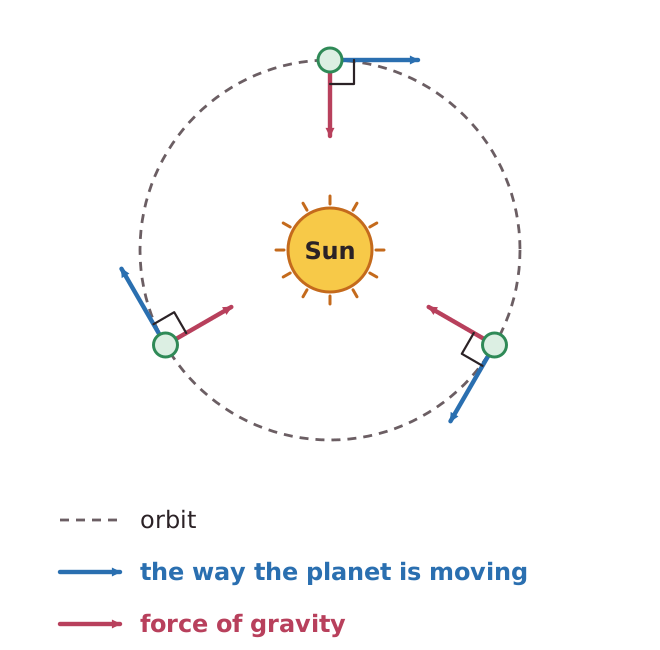
Velocity is a vector, so it has both a size (the speed) and a direction. A planet in a circular orbit moves at a constant speed, but its direction is always changing. Changing direction means changing velocity, so the planet is accelerating even though its speed stays the same.
The force that causes this is the gravitational pull of the Sun (or of a planet, for a moon or satellite). It always acts towards the centre of the orbit, at right angles to the direction of motion. Because the force has no part pushing forwards or backwards along the path, it cannot speed the planet up or slow it down. It only pulls the planet sideways, turning its direction. A force that acts towards the centre of a circle like this is called a centripetal force, and for orbits it is provided by gravity.