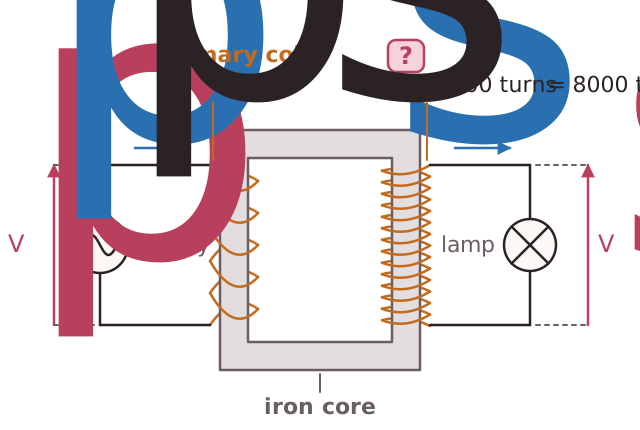
A transformer has a primary coil and a secondary coil wound on an iron core. The potential differences across the coils are in the same ratio as the numbers of turns: Vp ÷ Vs = Np ÷ Ns. A step-up transformer has more turns on the secondary coil than the primary, so the output potential difference is greater than the input. A step-down transformer has fewer turns on the secondary coil.
For a transformer that is 100% efficient, the power in equals the power out: Vp × Ip = Vs × Is. So when the potential difference is stepped up, the current is stepped down by the same factor. Real transformers are close to this.
Worked example: a step-up transformer has 500 turns on the primary coil and 8000 on the secondary, and the input is 25 000 V. The turns ratio is 8000 ÷ 500 = 16, so the output is 25 000 × 16 = 400 000 V. If the primary current is 800 A, the power is 20 000 000 W, and the secondary current is 20 000 000 ÷ 400 000 = 50 A.
This is the advantage of high voltage transmission. The current in the cables is 16 times smaller, so the heating in the cables is far lower and much less energy is wasted.