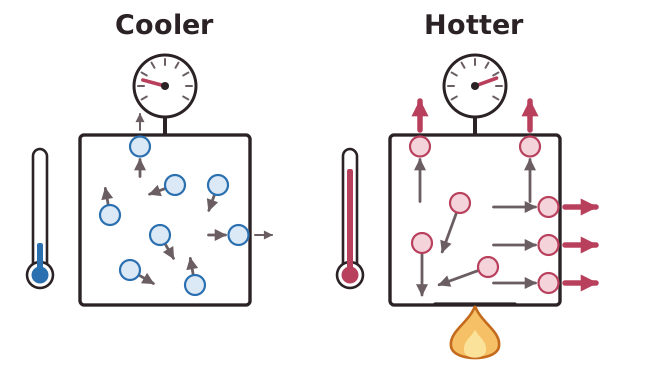
The particles in a gas move randomly at high speed. The pressure of a gas is caused by these particles colliding with the walls of the container. Each collision pushes on the wall with a tiny force, and billions of collisions every second add up to a steady pressure.
The temperature of a gas is linked to the average kinetic energy of its particles. When a gas is heated, its particles gain kinetic energy, so they move faster. Their velocity increases.
Now think about a fixed mass of gas in a sealed container of constant volume. The number of particles stays the same and the space they move in stays the same. If the temperature rises, the particles move faster. They hit the walls more often, and each collision is harder. The force on the walls increases, so the pressure increases. If the temperature falls, the particles move more slowly and the pressure decreases.
This is a qualitative idea at GCSE: higher temperature means higher pressure for a fixed mass of gas at constant volume. You do not need to do calculations with it.