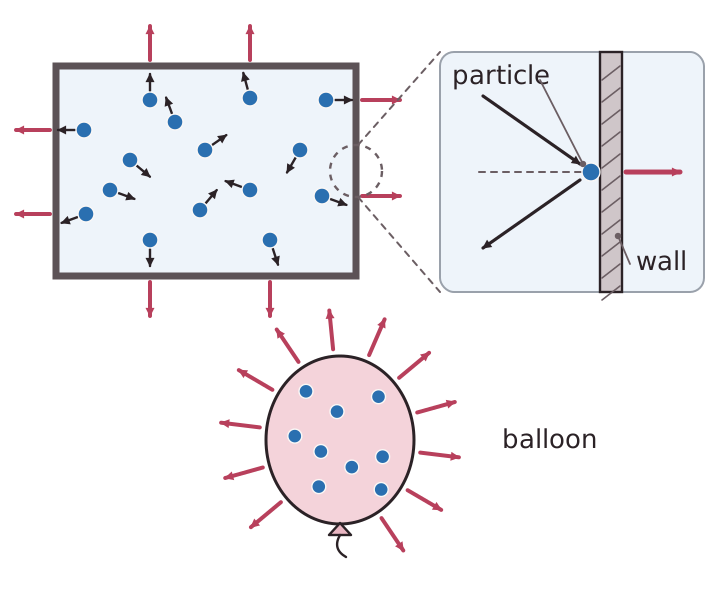
The particles of a gas move randomly at high speed. When a particle hits the wall of its container it bounces off. Its direction changes during the bounce, so the wall must exert a force on the particle. By Newton's third law, the particle exerts an equal force on the wall.
The force from one particle is tiny. But a container holds a huge number of particles, and each one hits the walls many times every second. All these collisions add up to a steady net force on the wall.
This force always acts at right angles to the surface. A particle bouncing off a wall reverses the part of its motion that is towards the wall, so the push on the wall is perpendicular to it. It is true for any surface the gas touches, whatever its shape. A balloon is pushed outwards evenly in all directions for this reason.
The force on each unit of area of the surface is the pressure of the gas: p = F ÷ A, with pressure in pascals (Pa), force in newtons (N) and area in m2.