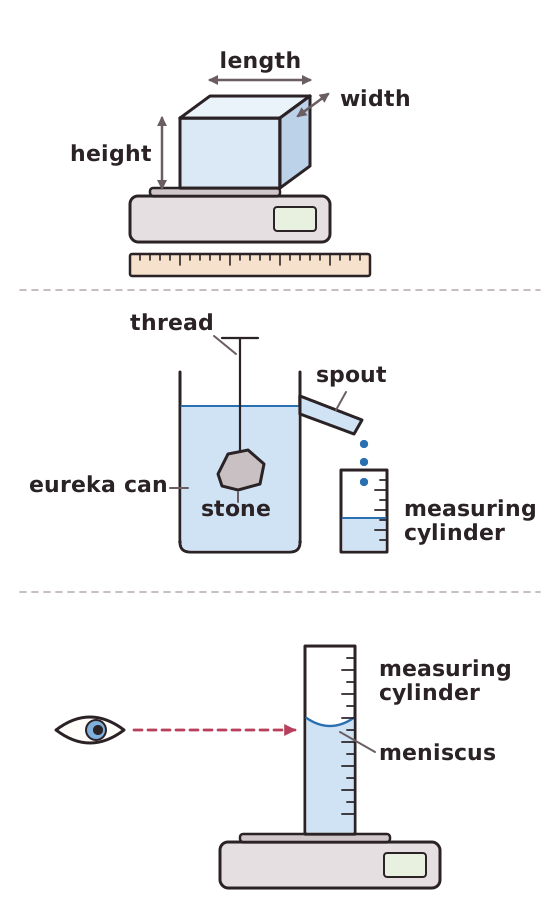
In this practical you find the density of a regular solid, an irregular solid and a liquid. For every sample you measure the mass and the volume, and then use density = mass ÷ volume.
Mass: use a balance. For a regular solid such as a block, put it on the balance and read the mass. For a liquid, put a measuring cylinder on the balance and set the reading to zero, then add the liquid and read the mass of the liquid alone.
Volume of a regular solid: measure the length, width and height with a ruler, then multiply them together. Volume of an irregular solid such as a stone: fill a eureka can with water until it runs out of the spout. Lower the stone in carefully on a thread. The stone displaces its own volume of water, and you collect this water in a measuring cylinder and read its volume. Volume of a liquid: read it from the scale on the measuring cylinder, with your eye level with the bottom of the meniscus.
Divide the mass by the volume to find the density. Repeat the measurements and take an average to improve accuracy. For example, a block of mass 120 g and volume 40 cm3 has a density of 3 g/cm3.