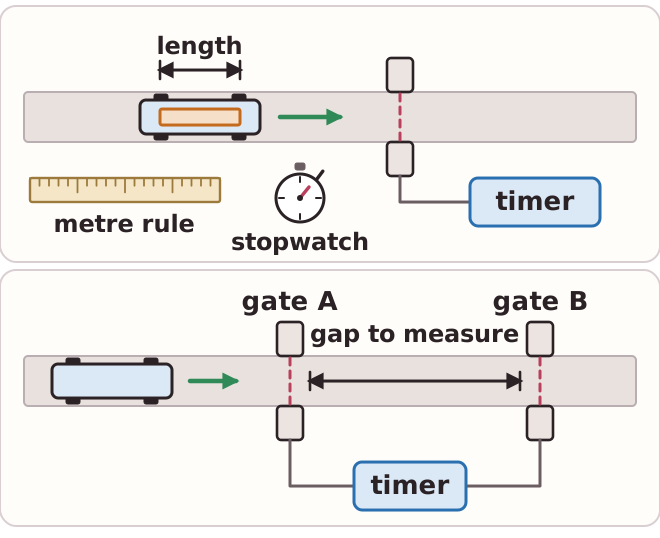
Speed = distance ÷ time, so to find the speed of an object you must measure a distance and a time. The simplest method uses a metre rule or tape measure to mark out a distance and a stopwatch to time the object over it. A stopwatch is started and stopped by hand, so human reaction time adds an error, especially when the time is short. To improve reliability, repeat the measurement and take the mean.
Light gates remove the reaction time error. A light gate is connected to a timer or data logger. Timing starts when an object breaks the beam of light and stops when the beam is no longer blocked.
- One light gate: fix a card of known length to a trolley. The gate times how long the card blocks the beam, and speed = length of the card ÷ time blocked. A 0.12 m card that blocks the beam for 0.04 s gives 0.12 ÷ 0.04 = 3 m/s.
- Two light gates a known distance apart: the timer measures the time between the gates, and the average speed = distance between the gates ÷ time taken.
A video can also be used. The object is filmed beside a ruler, and the distance moved between frames is measured. Because the frame rate is known, the time between frames is known, so the speed can be worked out.