Newton's first law says that a body stays at rest, or keeps moving at a constant velocity, unless a resultant force acts on it. Constant velocity means the same speed in the same direction. No force is needed to keep a body moving like this.
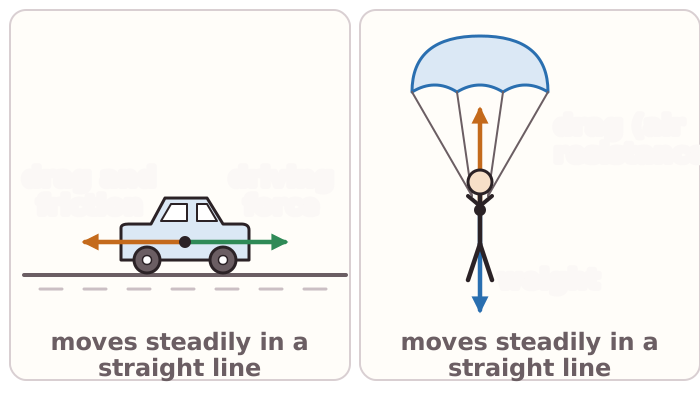
When the resultant force on a body is zero, the forces on it are balanced. A body at rest stays at rest. A moving body keeps its speed and direction. A car travelling at a steady speed in a straight line has a driving force that is equal to the resistive forces such as drag and friction, so the resultant force is zero. A parachutist falling at a steady speed in a straight line is another example.
When the resultant force is not zero, the forces are unbalanced and the velocity changes. The speed changes, or the direction changes, or both. A car driven round a bend at a steady speed is still changing direction, so its velocity is changing and there must be a resultant force on it.