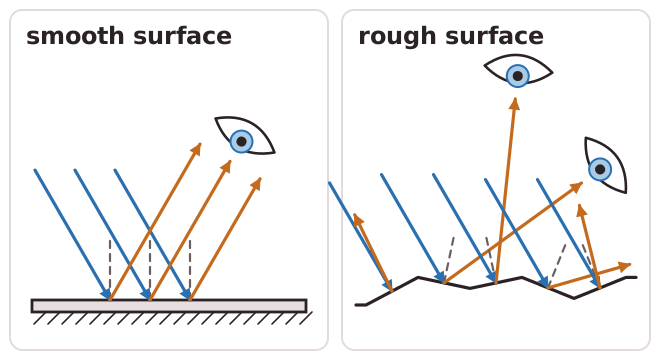
The law of reflection applies to every ray of light that hits a surface. What changes between surfaces is how the normals are arranged.
A smooth surface, such as a mirror or the still surface of a lake, gives specular reflection. At every point the normal points in the same direction. Parallel rays arriving at the surface are therefore reflected as parallel rays, so the reflected light keeps its pattern and you see a clear image.
A rough surface, such as paper or a wall, gives diffuse reflection. On a small scale the surface is uneven, so the normal points in many different directions. Each ray still obeys the law of reflection, but the reflected rays are scattered in all directions. No clear image forms, but light from the surface reaches your eye from almost any position, which is why you can read a page from any angle.
The same surface can change type. When wind makes ripples on a lake, the normals point in different directions and the reflection becomes diffuse.