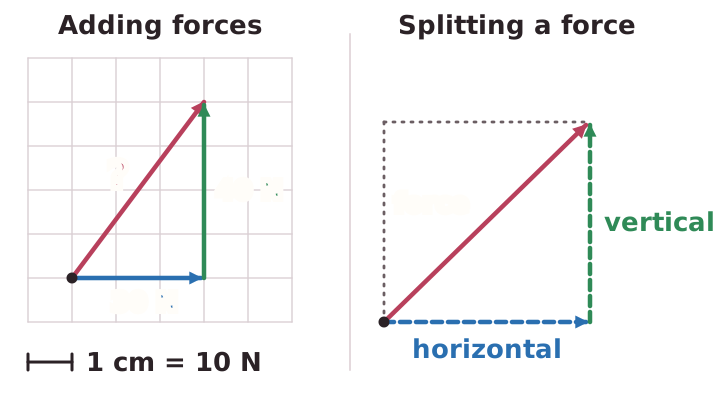
A force can be drawn as an arrow. The length of the arrow shows the magnitude of the force on a chosen scale, for example 1 cm for every 10 N, and the direction of the arrow shows the direction of the force. A scale drawing needs a ruler and a protractor, and the scale must be stated.
To find the resultant (net) force of two forces that are not in a straight line, draw the first arrow, then draw the second arrow starting from the end of the first, so the arrows go head to tail. The resultant is the arrow drawn from the start of the first arrow to the end of the last. Measure its length and convert back using the scale. For example, a 30 N force and a 40 N force at right angles are drawn 3 cm and 4 cm long. The resultant arrow measures 5 cm, so the net force is 50 N.
Resolving a force is the opposite job. A single force is split into two components at right angles to each other, usually horizontal and vertical. On a scale drawing the force is the diagonal of a rectangle, and the two sides of the rectangle are the components.
If an object is in equilibrium the net force on it is zero. When all the force arrows are drawn head to tail they return exactly to the starting point and form a closed shape, such as a triangle.