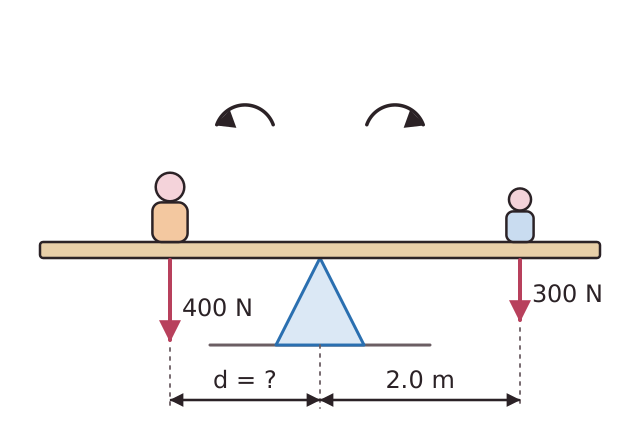
An object that is not turning is in equilibrium. When this happens the forces trying to turn it one way are exactly cancelled by the forces trying to turn it the other way, so the resultant moment about the pivot is zero.
This is the principle of moments: for an object in equilibrium, the sum of the clockwise moments about a pivot equals the sum of the anticlockwise moments about the same pivot. A seesaw is a good example. A heavy child sits close to the pivot and a light child sits far from it, and the seesaw balances.
To use the principle, work out each moment as force × perpendicular distance, add up the moments on each side, then make the two totals equal. Example: a 300 N child sits 2.0 m from the pivot, so the clockwise moment is 300 × 2.0 = 600 N m. A 400 N child must give an anticlockwise moment of 600 N m, so 400 × d = 600 and d = 1.5 m. Moving a weight closer to the pivot reduces its moment.