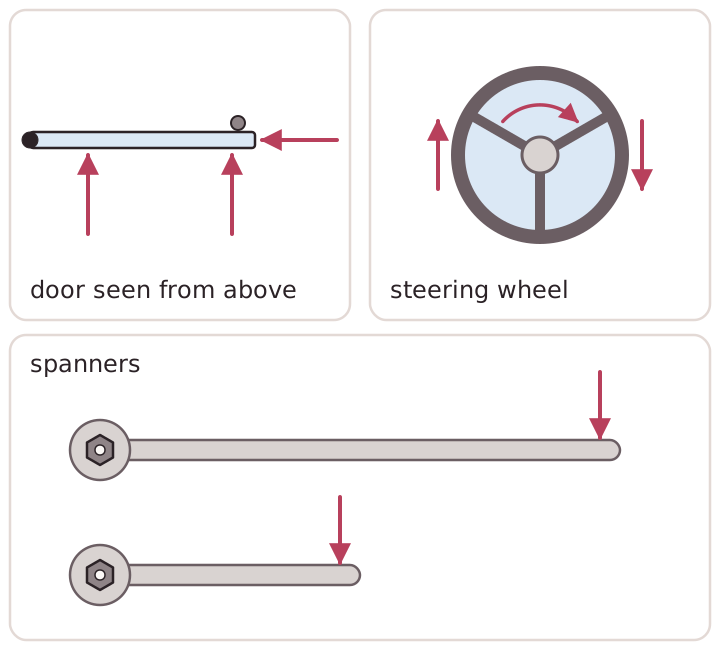
A force can do more than push an object along. If the object is fixed at one point, the force can make it turn. The fixed point is called the pivot. A door turns about its hinge, a seesaw about its middle, and a wheel about its axle. The turning effect of a force is called its moment.
Where and how you push matters. A force applied far from the pivot gives a bigger turning effect than the same force applied close to it, which is why a door handle is placed at the far edge from the hinge. Pushing near the hinge gives a smaller turning effect. A longer spanner loosens a stuck nut more easily for the same reason. The force also works best when it is perpendicular to the line joining the pivot to the point where you push, that is, at right angles to the spanner or door. A force whose line of action passes straight through the pivot has no turning effect, so pushing a door along its own surface towards the hinge does not rotate it.
Some situations involve two forces. Turning a steering wheel with a hand on each side uses two equal forces in opposite directions that act along different lines. Together they have a resultant force of zero, so the wheel does not move sideways, but it still rotates. Pedals, scissors, spanners, taps and cranks all use forces to cause rotation in the same way.