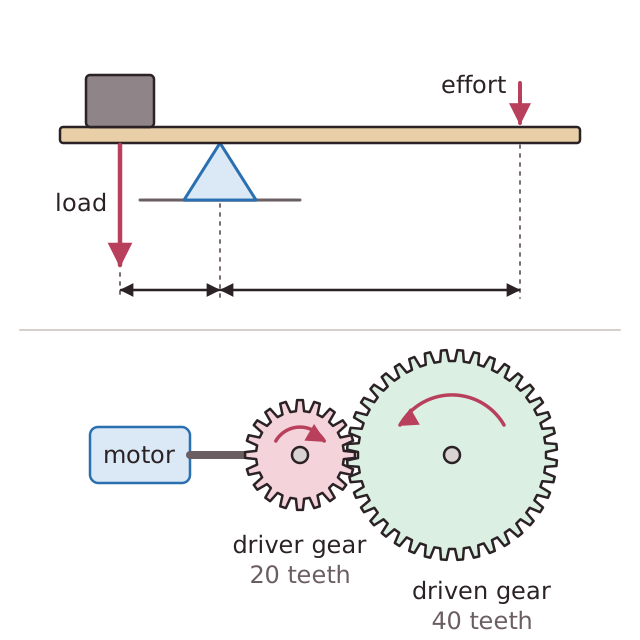
A lever is a rigid bar that turns about a pivot. You apply a force called the effort at one point to move a load at another point. The bar transmits the turning effect of the effort to the load. When the lever balances, the moment of the effort equals the moment of the load, and the clockwise and anticlockwise moments are equal. If the effort acts far from the pivot and the load is close to it, a small effort has a large moment, so it can balance or lift a large load. A crowbar and a wheelbarrow work this way. The price is that the effort must move through a longer distance than the load.
Gears are toothed wheels that mesh together. A turning gear pushes on the teeth of the next gear, so it transmits the turning effect of a force and makes the next gear turn in the opposite direction. The gear that is turned by a motor is the driver gear, and the one it turns is the driven gear.
Gears of different sizes change the moment and the speed. The larger gear has more teeth. A driver gear with 20 teeth turning a driven gear with 40 teeth makes the driven gear turn at half the speed, but with twice the moment, ignoring friction. So a driver gear turning a larger gear gives a larger moment and a slower rotation. Turning a smaller gear does the opposite, giving a smaller moment but a faster rotation.