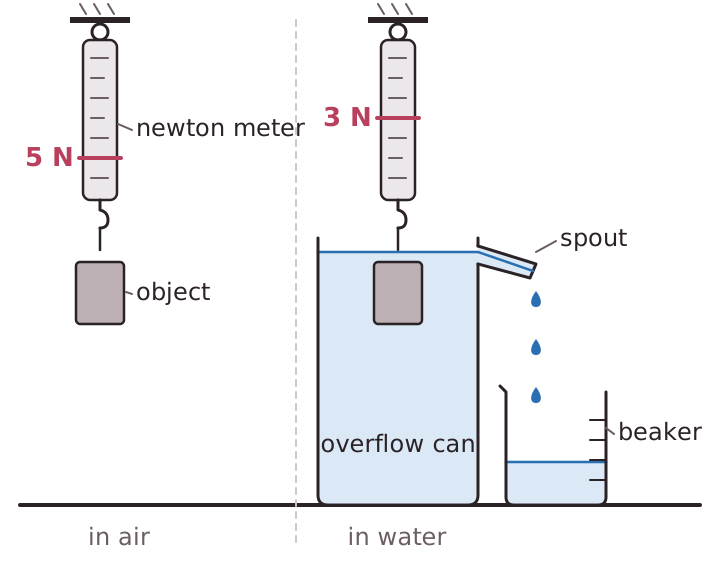
When an object is placed in a fluid it pushes some of the fluid out of the way. The fluid that is pushed aside is said to be displaced. A fully immersed object displaces a volume of fluid equal to its own volume. A partly immersed object displaces a volume equal to the part that is under the surface.
The upthrust on an object is equal to the weight of the fluid it displaces. This is known as Archimedes' principle. Suppose an object displaces 2 kg of water. With g = 10 N/kg the weight of that water is 2 × 10 = 20 N, so the upthrust on the object is 20 N.
The upthrust can be measured with a newton meter. An object weighs 5 N in air. When it hangs fully in water the reading falls to 3 N, a loss in apparent weight of 2 N. This 2 N is the upthrust, and it equals the weight of the water the object displaced. Repeating the test in different liquids shows how the upthrust changes with the liquid.