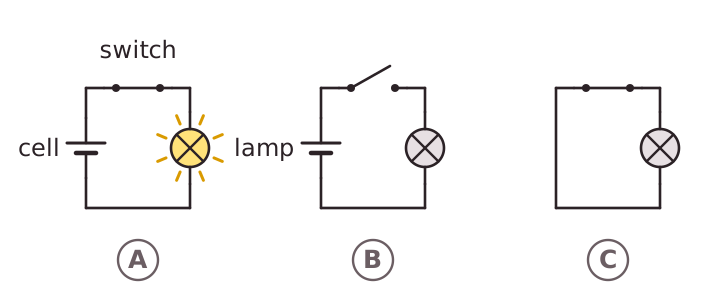
For there to be a current in a circuit, two things are needed. There must be a source of potential difference, such as a cell, a battery or a power supply. The circuit must also be closed, which means it forms a complete loop with no gaps.
The source of potential difference pushes the charge around. In a metal wire the charge carriers are electrons, so the cell pushes the electrons round the loop and there is a current. If the circuit includes a source and is closed, there is a current in the circuit.
If you open a switch, you make a gap in the circuit. The loop is broken, so the current is zero everywhere in the circuit and a lamp goes out. A circuit with no source of potential difference has no current either, even if it is a complete loop.