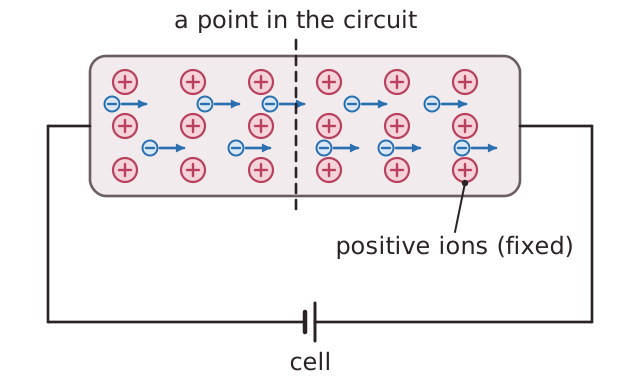
An electric current is the rate of flow of electric charge. The more charge that passes a point in the circuit each second, the bigger the current. A current of 2 A moves twice as much charge past a point every second as a current of 1 A.
A metal is made of fixed positive ions with some electrons that are free to move. These free electrons are negatively charged. When a cell is connected in a complete circuit, it pushes these electrons around the wire. So in a metal, the current is a flow of electrons.
The electrons are already in the wire all the way round the circuit, which is why a lamp lights straight away when the switch is closed. Charge is measured in coulombs (C).