A projectile is an object upon which the only force is gravity.
The vertical and horizontal motions are independent.
Horizontally, the velocity is constant. As there is no horizontal force, there is no horizontal acceleration
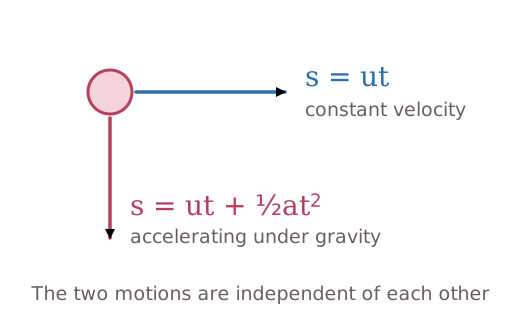
Horizontally, the motion is described by
s = u t
Vertically, the motion is described by
s = ut + ½gt2
as it is accelerating due to gravity.
A ball is thrown horizontally with a speed of 12ms-1 from a height of 21m
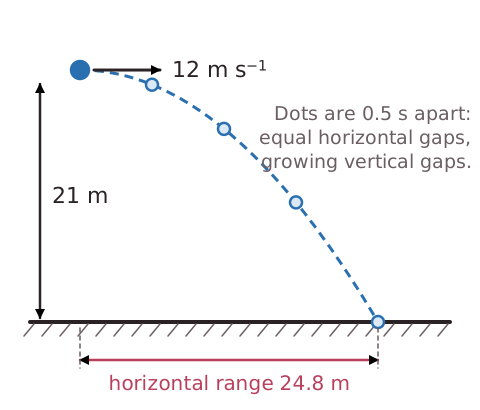
It stops when it hits the ground.
The time taken for it to hit the ground is given by s = ut + ½gt2
but ut = zero
So it hits the ground at t = √(2s/g) = √(2x21/9.81) = 2.07 seconds
Meanwhile it travels horizontally at 12ms-1 for 2.07 seconds
So its horizontal range is given by s = u t = 12 x 2.07 =24.8m
The vertical and horizontal motions are independent.
Horizontally, the velocity is constant. As there is no horizontal force, there is no horizontal acceleration
Horizontally, the motion is described by
s = u t
Vertically, the motion is described by
s = ut + ½gt2
as it is accelerating due to gravity.
A ball is thrown horizontally with a speed of 12ms-1 from a height of 21m
It stops when it hits the ground.
The time taken for it to hit the ground is given by s = ut + ½gt2
but ut = zero
So it hits the ground at t = √(2s/g) = √(2x21/9.81) = 2.07 seconds
Meanwhile it travels horizontally at 12ms-1 for 2.07 seconds
So its horizontal range is given by s = u t = 12 x 2.07 =24.8m