Acceleration is the rate of change of velocity. If the acceleration is uniform, this gives the formula:
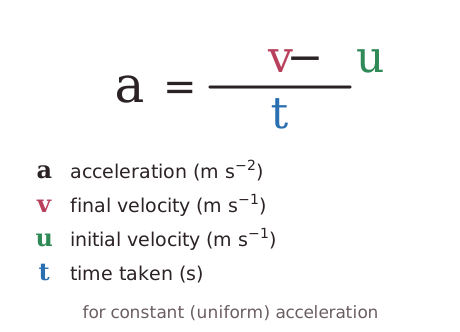
Rearranging gives the first equation of motion for uniform acceleration
1. v = u + at
The symbols used give the mnemonic suvat.
s = displacement, u = initial velocity, v = final velocity a = acceleration, t = time
In the following graph the object has constant acceleration.
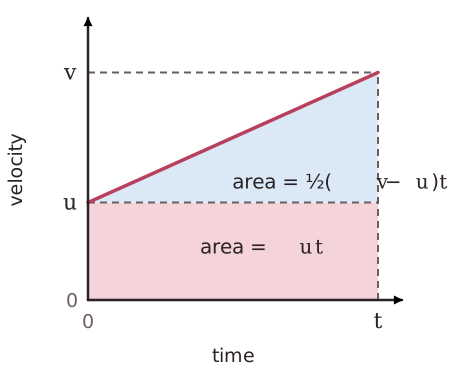
The displacement is the area under the graph.
Adding the two areas gives ½(v-u)t + ut
Substituting v = u + at gives the second equation of motion:
2. s = ut + ½at2
Treating the graph as a trapezium gives a third from the area:
3. s = ½(u + v) t
Substituting t = (v - u)/a into equation 3 gives:
4. v2 = u2 + 2as
finally, a fifth equation is possible:
5. s = vt - ½at2
Rearranging gives the first equation of motion for uniform acceleration
1. v = u + at
The symbols used give the mnemonic suvat.
s = displacement, u = initial velocity, v = final velocity a = acceleration, t = time
In the following graph the object has constant acceleration.
The displacement is the area under the graph.
Adding the two areas gives ½(v-u)t + ut
Substituting v = u + at gives the second equation of motion:
2. s = ut + ½at2
Treating the graph as a trapezium gives a third from the area:
3. s = ½(u + v) t
Substituting t = (v - u)/a into equation 3 gives:
4. v2 = u2 + 2as
finally, a fifth equation is possible:
5. s = vt - ½at2