The displacement of an object is given by the area under its velocity-time graph. This is because displacement = velocity × time, and each small strip under the graph has an area equal to velocity × time interval.
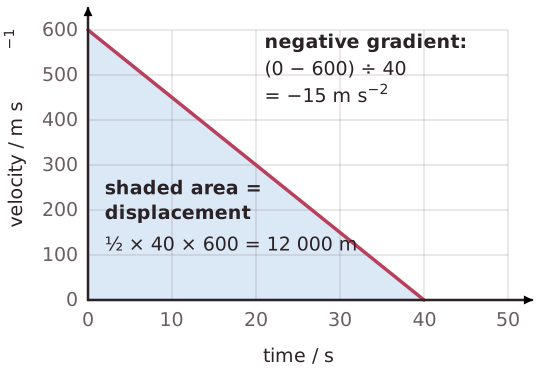
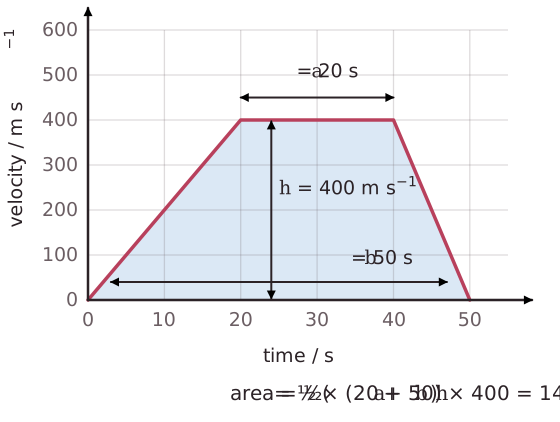
For constant velocity the area is a rectangle. For uniform acceleration the area is a triangle or a trapezium. The area of a trapezium is ½(a + b)h, where a and b are the parallel sides and h is the perpendicular distance between them. On a velocity-time graph, a and b are the initial and final velocities and h is the time.
For example, an object that accelerates uniformly from 4.0 m s-1 to 12 m s-1 in 5.0 s has a displacement of ½(4.0 + 12) × 5.0 = 40 m. When the line is curved, the area is estimated by counting squares.Areas below the time axis represent displacement in the opposite direction and count as negative. To find the total distance travelled, add all the areas as positive values instead.
Displacement on a Velocity-time Graph
Read the text
Read the text and highlight anything you think is important. When you go on, the text is hidden and you answer from memory.
Specification: OCR Physics A (H156), AS-level, 3.1.1 Kinematics. Topic: Forces and Motion.
Key terms in this lesson
- scalar quantity
- A quantity that has magnitude only, with no direction.
- friction
- A force that arises when two surfaces in contact move, or try to move, relative to each other, acting to oppose the relative motion.
- kinetic energy
- The energy an object possesses due to its motion.
- gravitational potential energy
- The energy an object possesses due to its position in a gravitational field.
- closed system
- A system of interacting objects on which no external forces act.
More in Forces and Motion
- Average Speed
- Displacement and Velocity
- Acceleration
- Equations of Motion - Uniform Acceleration
- Free Fall Under Gravity
- Projectile Motion
- Car Stopping Distances
- Weight, Mass, Acceleration
All 17 lessons in Forces and Motion · All OCR AS-level Physics topics