For current to flow you need:• a complete circuit• charged particles (e.g. electrons).• and a source of potential difference.The structure of a metal is a lattice of positively charged ions surrounded by free electrons called delocalised electrons. The ions do not move but vibrate about a fixed point. When the temperature increases the ions vibrate more. Most of the electrons are attached to the atom.Some electrons are delocalised and free to move through the metal.These electrons move towards the positive terminal if a potential difference is applied. A potential difference is created when one end of the conductor is made more positive than the other.
Liquids that carry an electric current are called electrolytes. Electrolytes are molten ionic compounds or solutions of ionic compounds. If a positive electrode(anode) and a negative electrode(cathode) are placed in the solution, positive ions move towards the cathode and negative ions move towards the anode.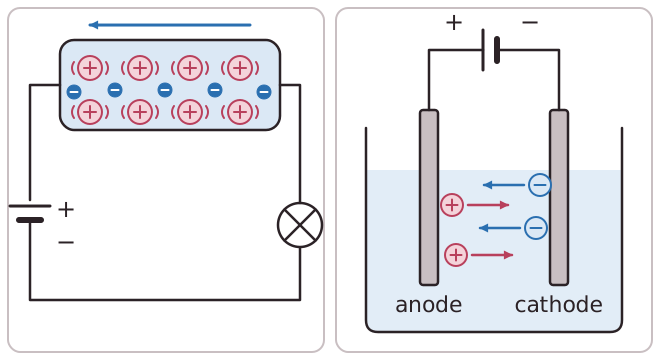
Liquids that carry an electric current are called electrolytes. Electrolytes are molten ionic compounds or solutions of ionic compounds. If a positive electrode(anode) and a negative electrode(cathode) are placed in the solution, positive ions move towards the cathode and negative ions move towards the anode.