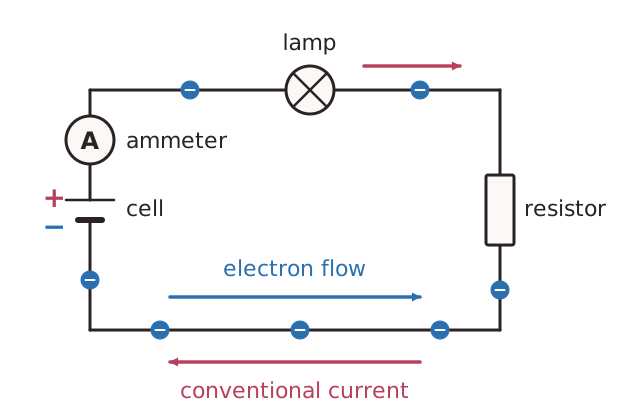
The flow of charged particles produces electric current. The size of the electric current is equal to the rate of flow of charge.I = ΔQ /ΔtI is electric current in amperes (A), ΔQ is electric charge transferred in coulombs (C). Electric current is the amount of charge passing a given point in a circuit per unit time (per second). 1 ampere is 1 coulomb of charge passing a given point in one second.1 A = 1 Cs-1An ammeter is used to measure electric current. Ammeters are placed in series and they should have negligible resistance so it does not decrease the current it is measuring. Electrons move around the circuit from the negative to positive terminal. However conventional current is from positive to negative.
Electric Current
Read the text
Read the text and highlight anything you think is important. When you go on, the text is hidden and you answer from memory.
Specification: OCR Physics A (H156), AS-level, 4.1.1 Charge. Topic: Electricity.
Key terms in this lesson
- displacement
- The distance an object has moved in a straight line from its starting point, in a particular direction.
More in Electricity
- Electric Charge
- Millikan's Oil Drop Experiment
- The Flow of Charge in Metals and Electrolytes
- Kirchhoff's First Law and Conservation of Charge
- Conductors and Semi-Conductors
- Current and Drift Velocity
- Potential Difference
- Electromotive Force
All 30 lessons in Electricity · All OCR AS-level Physics topics