The average velocity during uniform acceleration is halfway from the initial velocity to the final velocity.Since the distance is average speed × time, the distance is given by:s = ½ (u + v)t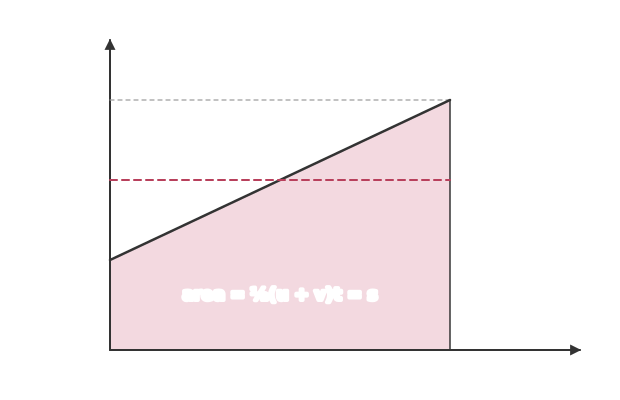
average velocity = (u + v) ÷ 2 On a velocity-time graph, uniform acceleration gives a straight line from u to v. The area under it is a trapezium with parallel sides u and v and width t, so its area is ½(u + v)t. This is the same result, because the area under a velocity-time graph is the displacement.Worked example: a car accelerates uniformly from 12 m s-1 to 20 m s-1 in 5.0 s. How far does it travel?s = ½(12 + 20) × 5.0 = 16 × 5.0 = 80 m The formula does not contain the acceleration, so it is useful when a is not given. Strictly, s is the displacement; for motion in one direction it equals the distance travelled.If the acceleration is not uniform, the average velocity is not (u + v) ÷ 2, and the distance must be found from the area under the actual velocity-time graph.