QuestionA potential divider consists of a fixed 2.0 kΩ resistor in series with a thermistor, connected to a 6.0 V supply of negligible internal resistance. The output p.d. Vout is taken across the thermistor. At 20 °C the thermistor has a resistance of 4.0 kΩ.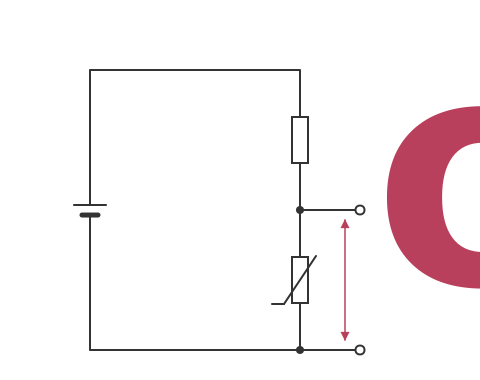
(b) The temperature rises and the thermistor's resistance falls to 1.0 kΩ. Calculate the new Vout.
(c) Explain, in terms of charge carriers, why the thermistor's resistance falls.(a)Vout = Vin × R2/(R1 + R2) = 6.0 × 4.0/(2.0 + 4.0) = 4.0 V (b)Vout = 6.0 × 1.0/(2.0 + 1.0) = 2.0 V The thermistor now has a smaller share of the total resistance, so it takes a smaller share of the supply p.d. The fixed resistor now has 4.0 V across it.(c) The thermistor is made of a semiconductor. As its temperature rises, more electrons gain enough energy to break free and become conduction electrons, so the number of charge carriers per unit volume, n, increases. From I = nqvA, more charge carriers give a larger current for the same p.d., so the resistance falls. (The lattice vibrates more too, but the increase in n has the much bigger effect.)Exam tip: in a potential divider you can leave the resistances in kΩ, because only their ratio matters.
(b) The temperature rises and the thermistor's resistance falls to 1.0 kΩ. Calculate the new Vout.
(c) Explain, in terms of charge carriers, why the thermistor's resistance falls.(a)