Evidence for the de Broglie Hypothesis consists of a narrow beam of electrons directed at a thin metal foil.The electrons are diffracted and form a pattern of rings on a fluorescent screen.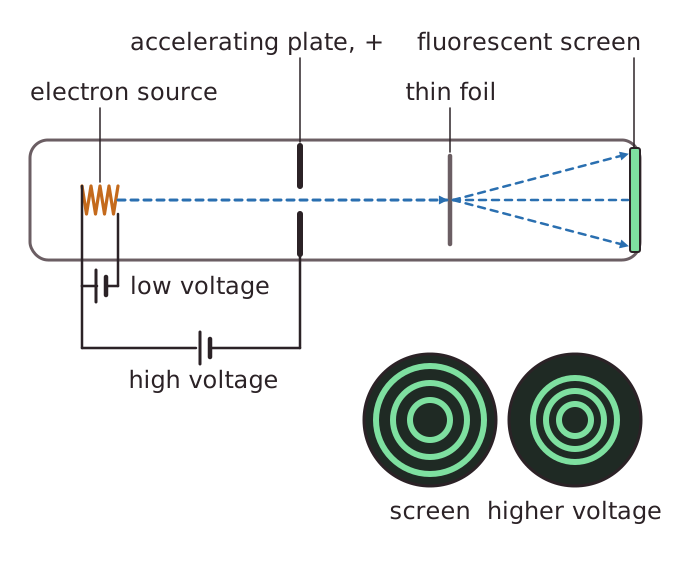 If the speed of electrons is increased the rings become smaller as the de Broglie wavelength decreases.Electron microscopes use electrons as a source of radiation rather than visible light as electrons have a much smaller wavelength than visible light which has wavelengths of between 400-700nm.Since λ = h/momentum the faster the particles move, the shorter the wavelength.Electrons from a heated filament are accelerated by attraction to a positively charged metal plate with a hole at the centre.