 BRAINCAKE
Line Spectra
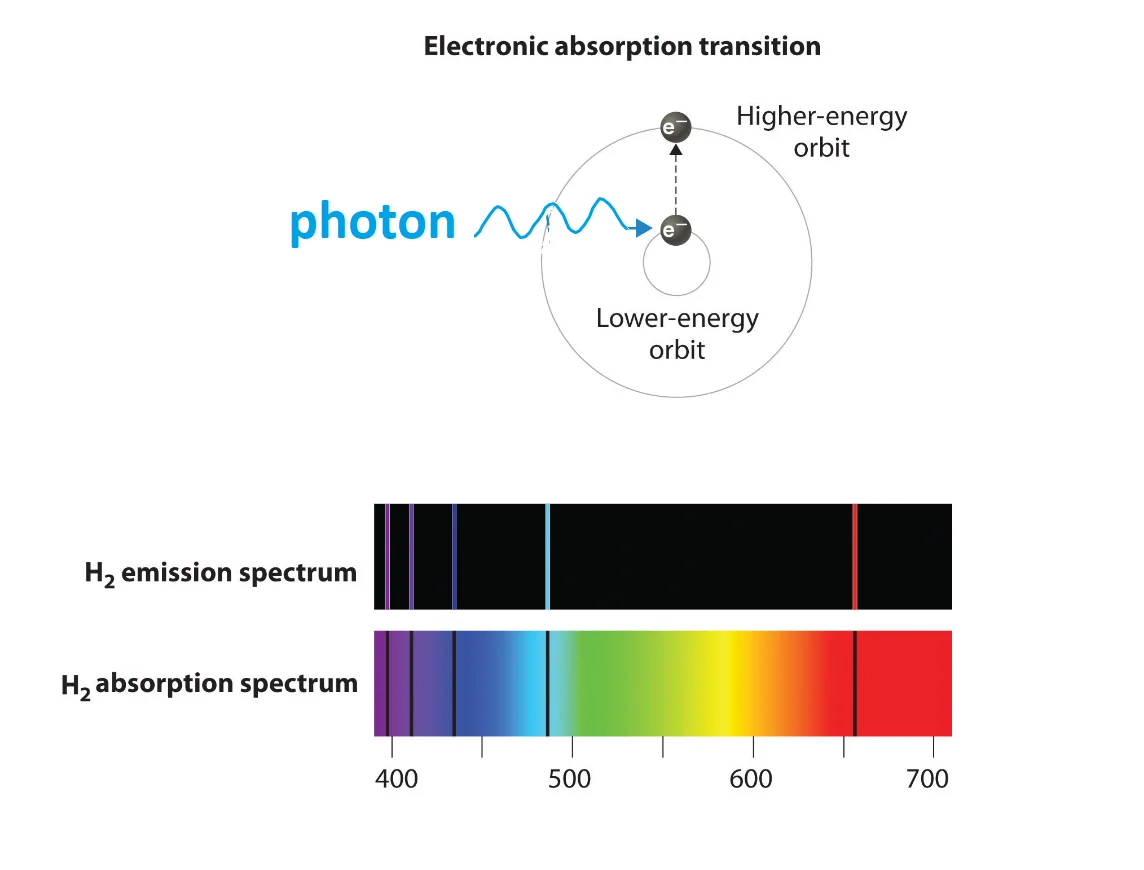
When the light from a hot gas is passed through a prism or diffraction grating, it forms a line spectrum: a set of sharp coloured lines at particular wavelengths on a dark background.
Electrons in an atom can only occupy discrete energy levels. When an excited electron drops from a higher level E1 to a lower level E2, the atom emits a single photon whose energy equals the difference between the levels, hf = E1 - E2.
Sign in free to see the rest of this lesson, the R.E.C.I.P.E. recall steps and the quiz
BrainCake is free. Make an account in seconds and pick up where this page stops.
Key terms in this lesson
- Photon
- A discrete packet, or quantum, of electromagnetic energy.
- De-excitation
- The process by which an electron in an excited atom falls to a lower energy level, emitting a photon whose energy equals the difference between the two levels.
More in The Photoelectric Effect
- Excitation Using Photons
- De-excitation
- Fluorescence
- Fluorescent Tube
- Excitation of Hydrogen Atoms
- The Discovery of Helium
- The Dual Nature of Light
- De Broglie's Hypothesis
All 19 lessons in The Photoelectric Effect · All AQA AS-level Physics topics