An object is in equilibrium when all the forces acting on it are balanced. There is no resultant force, so the object stays at rest or moves with constant velocity: ΣF = 0.
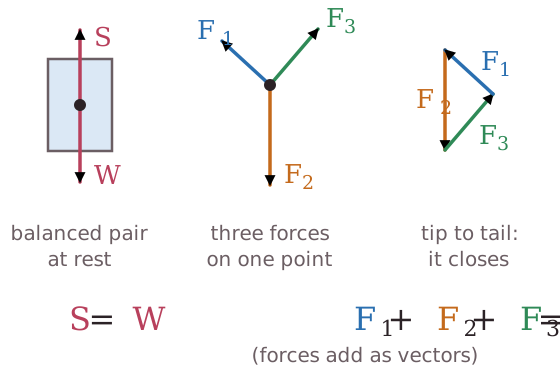
For forces acting in different directions, resolve each force into horizontal and vertical components. For equilibrium, the components in each direction must add up to zero: the total force to the left equals the total force to the right, and the total upward force equals the total downward force.For example, a weight W hanging from a washing line is held by tensions T1 and T2 at angles α and β to the horizontal. Resolving horizontally gives T1cosα = T2cosβ, and resolving vertically gives T1sinα + T2sinβ = W. These two equations can be solved for the two tensions.The flatter the line, the smaller the vertical components of the tensions, so the tensions must be larger to support the same weight. This is why a washing line can never be pulled perfectly straight when a load hangs from it.
Equilibrium
Read the text
Read the text and highlight anything you think is important. When you go on, the text is hidden and you answer from memory.
Specification: AQA Physics (7407), AS-level, 3.4.1.1 Scalars and vectors. Topic: Forces in Equilibrium.
More in Forces in Equilibrium
- Vector Quantities
- Adding Vectors - Scale Diagram
- Resolving Vectors
- Adding Two Perpendicular Vectors
- Three Forces in Equilibrium
- Moments
- The Principle of Moments
- Centre of Mass
All 20 lessons in Forces in Equilibrium · All AQA AS-level Physics topics