A vector quantity has both magnitude and direction. Examples include displacement, velocity, acceleration, force and momentum.A vector can be represented by an arrow drawn to scale. The length of the arrow represents the magnitude of the vector and the direction of the arrow shows its direction.
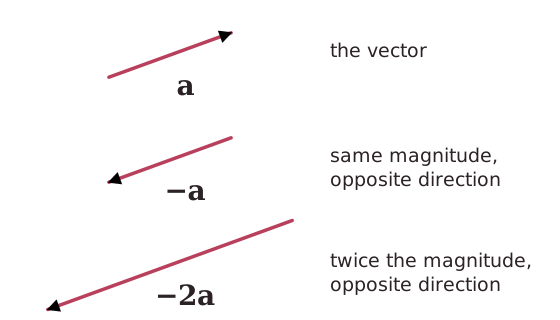
Adding two vectors gives their resultant. Subtracting one vector from another gives the change in the quantity, which is always the final value minus the initial value. A change in velocity can happen even when the speed stays constant, if the direction changes.Any vector can be resolved into two perpendicular components. A force F at an angle θ to the horizontal has a horizontal component Fcosθ and a vertical component Fsinθ. Each component acts independently, so it can be treated separately.
Vector Quantities
Read the text
Read the text and highlight anything you think is important. When you go on, the text is hidden and you answer from memory.
Specification: AQA Physics (7407), AS-level, 3.4.1.1 Scalars and vectors. Topic: Forces in Equilibrium.
More in Forces in Equilibrium
- Vector and Scalar Quantities
- Adding Vectors - Scale Diagram
- Resolving Vectors
- Adding Two Perpendicular Vectors
- Equilibrium
- Three Forces in Equilibrium
- Moments
- The Principle of Moments
All 20 lessons in Forces in Equilibrium · All AQA AS-level Physics topics