 BRAINCAKE
The Principle of Moments
The principle of moments states that for a body in (rotational) equilibrium, the sum of clockwise moments about any point is equal to the sum of anticlockwise moments about the same point.
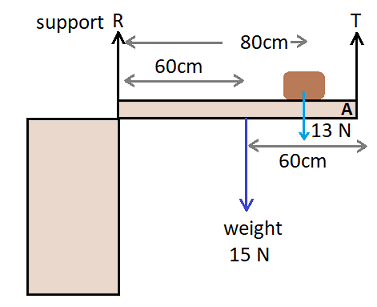
For example, a wooden beam 150cm long with a weight of 20N rests on a support at one end and is fixed to a vertical string at the other end.
Sign in free to see the rest of this lesson, the R.E.C.I.P.E. recall steps and the quiz
BrainCake is free. Make an account in seconds and pick up where this page stops.
Key terms in this lesson
- Equilibrium
- An object is in equilibrium when the resultant force and the resultant moment acting on it are both zero.
- Moment
- The turning effect of a force about a pivot, equal to the force multiplied by the perpendicular distance from the pivot to the line of action of the force.
More in Forces in Equilibrium
- Adding Two Perpendicular Vectors
- Equilibrium
- Three Forces in Equilibrium
- Moments
- Centre of Mass
- Couples
- Stable Equilibrium
- Tilting and Toppling
All 20 lessons in Forces in Equilibrium · All AQA AS-level Physics topics