All vectors can be split into two components perpendicular to each other.This is known as resolving vectors.The horizontal component will be equal to the vector multiplied by the cosine of the angle it makes to the horizontal. The vertical component will be equal to the vector multiplied by the sine of the angle it makes to the horizontal.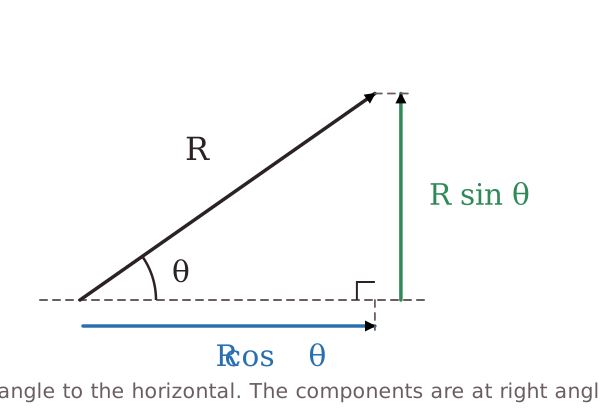 An object on a slope has its weight acting downwards. This can be resolved into two components parallel and perpendicular to the slope.The perpendicular component is the weight multiplied by the cosine of the angle the slope makes with the horizontal.The parallel component is the weight multiplied by the sine of the angle the slope makes with the horizontal.:
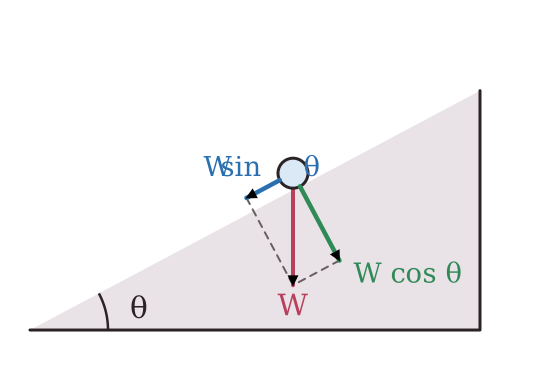
An object on a slope has its weight acting downwards. This can be resolved into two components parallel and perpendicular to the slope.The perpendicular component is the weight multiplied by the cosine of the angle the slope makes with the horizontal.The parallel component is the weight multiplied by the sine of the angle the slope makes with the horizontal.: