The Doppler effect is the change in the observed wavelength and frequency of a wave when its source moves relative to the observer. When the source moves away, the waves are stretched out: the observed wavelength increases and the frequency decreases. When the source moves towards the observer, the observed wavelength decreases.For light from a galaxy moving away from us, the spectral lines are shifted towards the red end of the spectrum. This is called red shift. A galaxy moving towards us shows blue shift. The absorption lines keep the same pattern, so they can be recognised and compared with the wavelengths measured in a laboratory.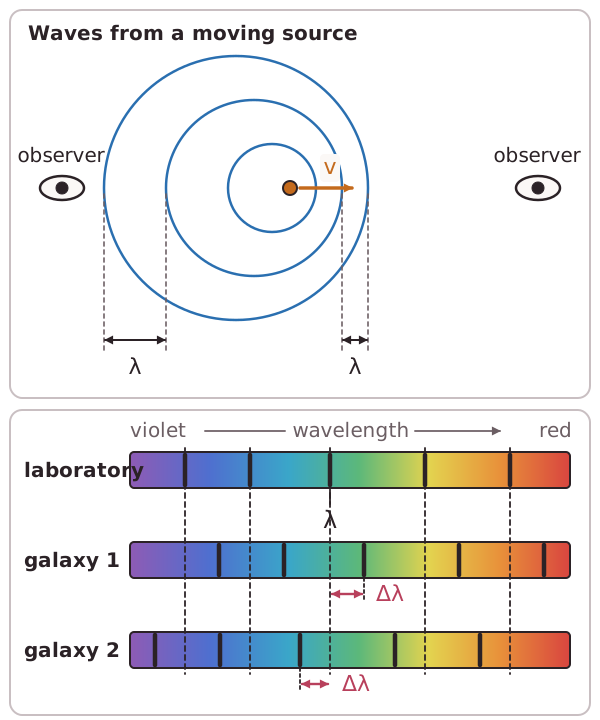 For speeds much less than the speed of light, the Doppler equation is:
Δλ/λ ≈ Δf/f ≈ v/c where Δλ is the change in wavelength, λ is the wavelength emitted by the source (the laboratory value), v is the speed of the source relative to the observer (its recession speed) and c is the speed of light.Worked example: a hydrogen line has a laboratory wavelength of 656 nm. In a galaxy's spectrum it appears at 663 nm. Find the galaxy's recession speed.
Δλ = 663 − 656 = 7 nm
v = c × Δλ/λ = 3.00 × 108 × 7/656 = 3.2 × 10⁶ m s−1Light from almost all distant galaxies is red-shifted, so almost all galaxies are moving away from us.
For speeds much less than the speed of light, the Doppler equation is:Δλ = 663 − 656 = 7 nm
v = c × Δλ/λ = 3.00 × 108 × 7/656 = 3.2 × 10⁶ m s−1Light from almost all distant galaxies is red-shifted, so almost all galaxies are moving away from us.