Almost every galaxy shows a red shift, and the red shift increases with distance (Hubble's law). This is interpreted as meaning that the universe is expanding.It is not that galaxies are flying outwards from a centre, with us at the middle. Instead space itself is expanding, carrying galaxies apart. Every galaxy sees all the others moving away, with more distant ones receding faster, so there is no centre and no edge. A common model is dots drawn on a balloon: as it inflates, every dot moves away from every other dot, and dots twice as far apart separate twice as fast.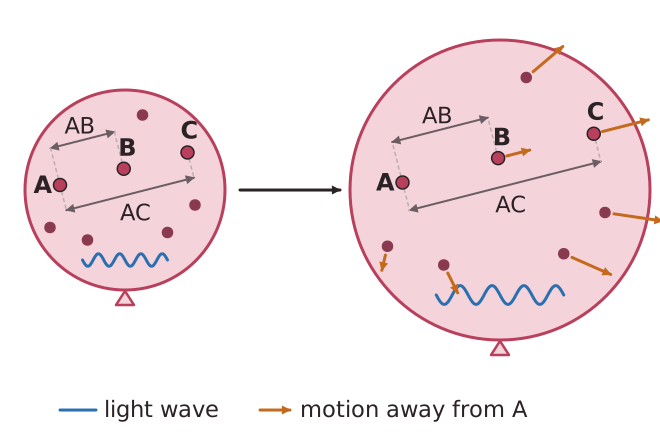 As light travels through expanding space, its wavelength is stretched along with space. This cosmological red shift is why z grows with distance: light from further away has travelled for longer through expanding space.A few nearby galaxies, such as Andromeda, show blue shift. They are close enough for gravitational attraction to overcome the expansion locally, so they are moving towards us.Tracing the expansion back in time suggests the universe began in an extremely hot, dense state about 14 billion years ago, the Big Bang. Further evidence is the cosmic microwave background radiation, detected from all directions, which is radiation from the early hot universe red-shifted to microwave wavelengths.Galaxies themselves, and objects within them, do not expand, because gravity holds them together.