 BRAINCAKE
Trigonometric Parallax
Trigonometric parallax is used to measure the distance to nearby stars. As Earth orbits the Sun, a nearby star appears to move against the background of much more distant stars, which seem fixed.
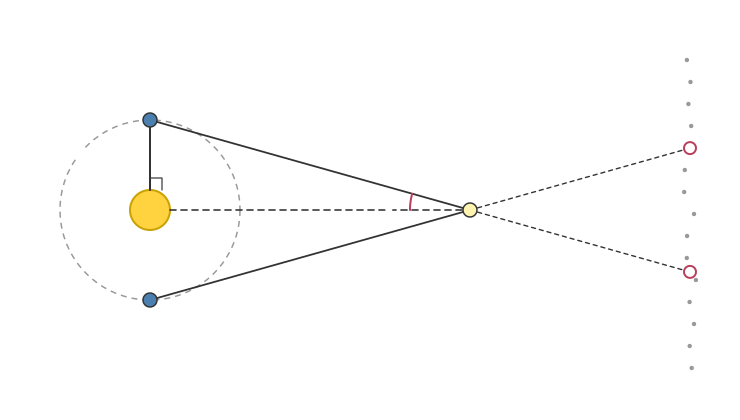
The star's position is measured, then measured again six months later, when Earth is on the opposite side of its orbit. The parallax angle p is half the angle through which the star appears to move. It is the angle the radius of Earth's orbit, r = 1 AU = 1.50 × 10¹¹ m, subtends at the star.
Sign in free to see the rest of this lesson, the R.E.C.I.P.E. recall steps and the quiz
BrainCake is free. Make an account in seconds and pick up where this page stops.
Key terms in this lesson
- astronomical unit
- The mean distance between the Earth and the Sun, about 1.50 × 10<sup>11</sup> m, used as a unit of distance within the Solar System.
More in Space
- The Hertzsprung-Russell Diagram
- Formation of a Star
- Life Cycle of a Star
- White Dwarfs, Neutron Stars and Black Holes
- Standard Candles
- The Doppler Effect and Red Shift
- Hubble's Law
- The Age of the Universe
All 18 lessons in Space · All Edexcel A-level Physics topics