When fusion stops, what is left of a star's core is a compact remnant. Which kind depends on the mass of the core.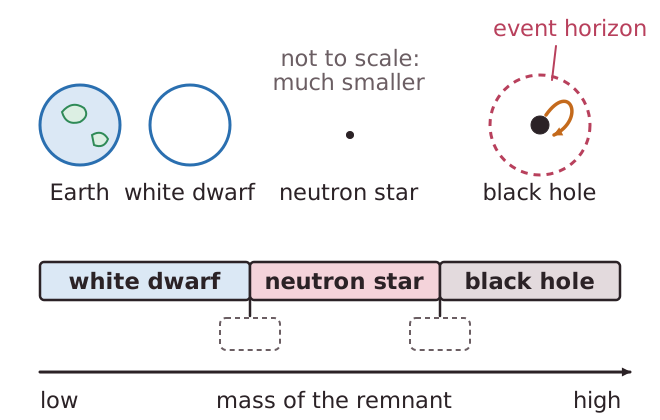 White dwarf. The core left after a low-mass star sheds its outer layers. It is about the size of Earth but contains around half to one solar mass, so its density is enormous (about 109 kg m−3). No fusion takes place; it shines because it is still very hot, and slowly cools over billions of years. Its small surface area gives it low luminosity, which is why white dwarfs sit at the bottom left of the H-R diagram. Collapse is stopped by the pressure of its tightly packed electrons.If the core has a mass above about 1.4 solar masses (the Chandrasekhar limit), electron pressure cannot stop gravity and the core collapses further, during a supernova.Neutron star. The collapse forces protons and electrons to combine into neutrons. The result is a ball of neutrons only about 10 km in radius, with a density similar to an atomic nucleus (about 1017 kg m−3). Many spin rapidly and emit beams of radio waves, and are observed as pulsars.Black hole. If the remaining core is more than about 3 solar masses, even neutrons cannot resist gravity and the core collapses to a point. The gravitational field is so strong that the escape velocity is greater than the speed of light, so nothing, not even light, can escape from inside a boundary called the event horizon. Black holes are detected by their effect on nearby matter.