Dark matter is matter that does not emit or absorb electromagnetic radiation, so it cannot be seen. It can only be detected through its gravitational effects.Evidence from galaxy rotation. Stars orbit the centre of a spiral galaxy, the gravitational force providing the centripetal force:GMm/r2 = mv2/r, so v = √(GM/r) where M is the mass inside the orbit. Most visible matter is near the centre, so stars far out should orbit more slowly as r increases. In fact their orbital speeds stay roughly constant out to the edge. The only explanation consistent with gravity is that the enclosed mass keeps increasing with r: the galaxy contains a halo of unseen mass, several times the visible mass.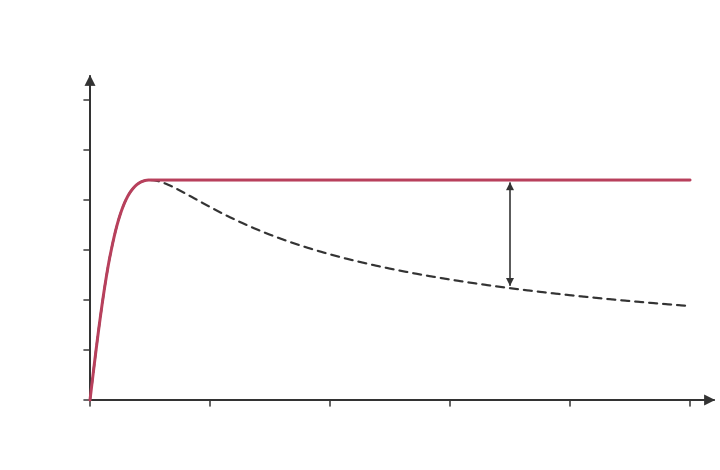
M = v2r/G = (2.2 × 10⁵)2 × 2.0 × 1020 ÷ 6.67 × 10−11 = 1.5 × 1041 kg If the visible stars and gas add up to much less than this, the rest is dark matter.Galaxies in clusters also move too fast to be held by their visible mass, and light is bent (gravitationally lensed) more than visible mass can explain.What dark matter is made of is unknown. Because the amount of dark matter is uncertain, the average density of the universe is uncertain, which makes its ultimate fate hard to predict.