 BRAINCAKE
The Cyclotron
A cyclotron is a circular accelerator. It has two hollow, D-shaped electrodes called dees, with a gap between them, in an evacuated chamber. A uniform magnetic field acts perpendicular to the dees, and an alternating p.d. is connected across them.
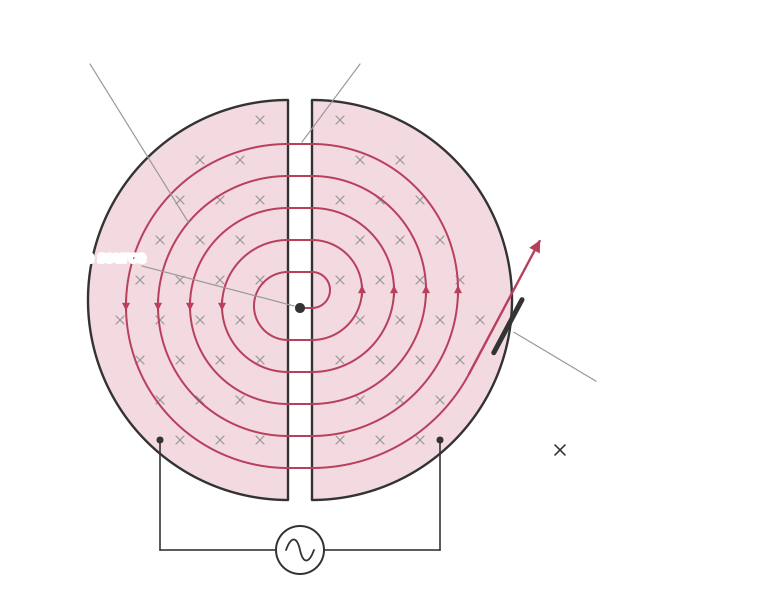
How it works:
• Charged particles are released near the centre.
• Inside a dee there is no electric field. The magnetic force BQv provides the centripetal force, so the particle moves in a semicircle at constant speed.
• Each time the particle crosses the gap, the p.d. has reversed, so it is accelerated.
• As its momentum increases, the radius increases (r = p/BQ), so the particle spirals outwards until it is deflected out at the edge.
Sign in free to see the rest of this lesson, the R.E.C.I.P.E. recall steps and the quiz
BrainCake is free. Make an account in seconds and pick up where this page stops.
More in Particle Physics
- Alpha Particle Scattering and the Nuclear Model
- Particle Accelerators
- The Linear Accelerator
- Particle Detectors
- Tracks in a Magnetic Field
- Relativistic Energies and GeV
- Mass in MeV/c2
- Particles and Antiparticles
All 19 lessons in Particle Physics · All Edexcel A-level Physics topics