Particle accelerators give charged particles very high energies. Fast particles can then be collided with a fixed target or with each other. High energies are needed to probe very small structures and to create new, massive particles from energy (ΔE = c2Δm).Accelerators use two kinds of field:• Electric fields accelerate the particles. The field does work on a charged particle, increasing its kinetic energy. A charge Q accelerated through a potential difference V gains energy:E = QV
Only charged particles can be accelerated this way.
• Magnetic fields steer and focus the beam. The magnetic force F = BQv acts at right angles to the velocity, so it changes the particle's direction but not its speed, and does no work on it. Magnetic fields bend beams into circular paths and keep them narrow.There are two main designs: linear accelerators (linacs), where particles travel in a straight line through many accelerating gaps, and circular accelerators such as the cyclotron and synchrotron, where magnetic fields bring the particles round repeatedly so they can be accelerated many times.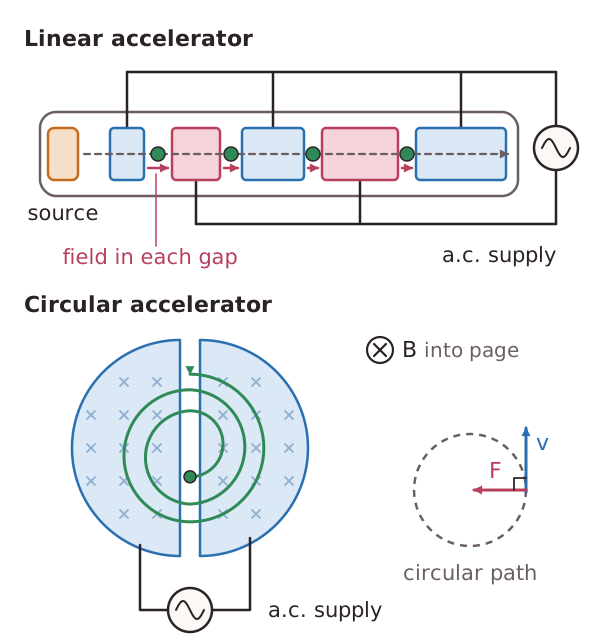 The beam travels in pipes kept at a vacuum, so particles do not collide with air molecules.Worked example: a proton (Q = 1.6 × 10⁻¹⁹ C) is accelerated through a p.d. of 5.0 MV.
E = QV = 1.6 × 10-19 × 5.0 × 106 = 8.0 × 10⁻¹³ J, which is 5.0 MeV.
Only charged particles can be accelerated this way.
• Magnetic fields steer and focus the beam. The magnetic force F = BQv acts at right angles to the velocity, so it changes the particle's direction but not its speed, and does no work on it. Magnetic fields bend beams into circular paths and keep them narrow.There are two main designs: linear accelerators (linacs), where particles travel in a straight line through many accelerating gaps, and circular accelerators such as the cyclotron and synchrotron, where magnetic fields bring the particles round repeatedly so they can be accelerated many times.
The beam travels in pipes kept at a vacuum, so particles do not collide with air molecules.Worked example: a proton (Q = 1.6 × 10⁻¹⁹ C) is accelerated through a p.d. of 5.0 MV.E = QV = 1.6 × 10-19 × 5.0 × 106 = 8.0 × 10⁻¹³ J, which is 5.0 MeV.