A charged particle moving at right angles to a uniform magnetic field experiences a forceF = BQv This force is always perpendicular to the velocity, so it provides a centripetal force and the particle moves in a circle. Setting BQv = mv2/r givesr = p / BQ where p = mv is the momentum. So from a track in a known field:
• greater momentum gives a larger radius (a straighter track)
• greater charge gives a smaller radius
• positive and negative particles curve in opposite directions; Fleming's left-hand rule gives the direction (for a negative particle, the current is opposite to its motion)
• a particle that loses energy as it ionises loses momentum, so its radius shrinks and the track spirals inwardsMeasuring the radius of a track therefore gives the momentum of the particle. If the particle's mass is known, its speed and (non-relativistic) kinetic energy follow.Worked example: a proton makes a track of radius 0.25 m in a field of 0.50 T.
p = BQr = 0.50 × 1.6 × 10-19 × 0.25 = 2.0 × 10⁻²⁰ kg m s-1
v = p/m = 2.0 × 10⁻²⁰ / 1.67 × 10-27 = 1.2 × 10⁷ m s-1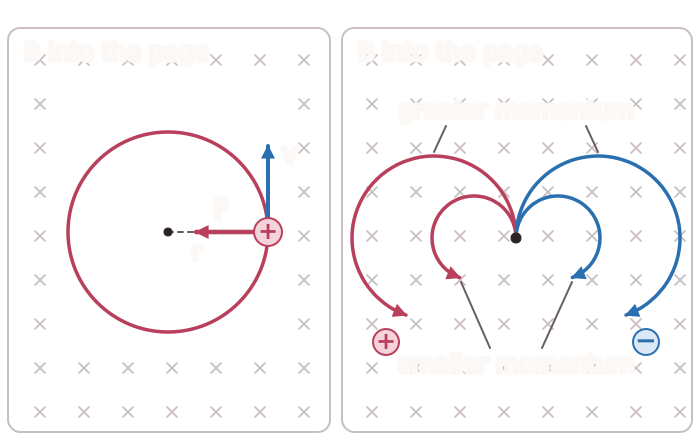
• greater momentum gives a larger radius (a straighter track)
• greater charge gives a smaller radius
• positive and negative particles curve in opposite directions; Fleming's left-hand rule gives the direction (for a negative particle, the current is opposite to its motion)
• a particle that loses energy as it ionises loses momentum, so its radius shrinks and the track spirals inwardsMeasuring the radius of a track therefore gives the momentum of the particle. If the particle's mass is known, its speed and (non-relativistic) kinetic energy follow.Worked example: a proton makes a track of radius 0.25 m in a field of 0.50 T.
p = BQr = 0.50 × 1.6 × 10-19 × 0.25 = 2.0 × 10⁻²⁰ kg m s-1
v = p/m = 2.0 × 10⁻²⁰ / 1.67 × 10-27 = 1.2 × 10⁷ m s-1