 BRAINCAKE
Alpha Particle Scattering and the Nuclear Model
In 1909, Geiger and Marsden, working with Rutherford, fired a narrow beam of alpha particles at a very thin gold foil. The apparatus was in a vacuum, so the alpha particles were not absorbed by air. A detector (a zinc sulfide screen that flashes when hit, viewed through a microscope) was moved around the foil to count the alpha particles scattered at each angle.
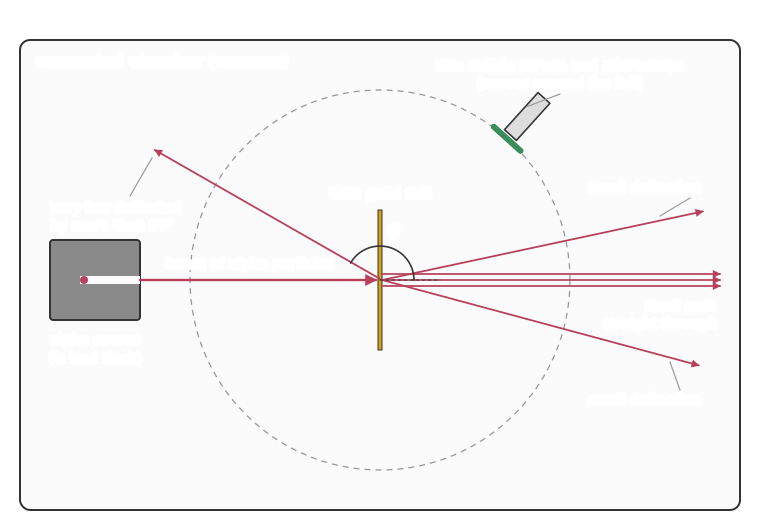
Observations and conclusions:
• Almost all the alpha particles passed straight through or were deflected by only small angles. So the atom is mostly empty space.
Sign in free to see the rest of this lesson, the R.E.C.I.P.E. recall steps and the quiz
BrainCake is free. Make an account in seconds and pick up where this page stops.
More in Particle Physics
- Particle Accelerators
- The Linear Accelerator
- The Cyclotron
- Particle Detectors
- Tracks in a Magnetic Field
- Relativistic Energies and GeV
- Mass in MeV/c2
- Particles and Antiparticles
All 19 lessons in Particle Physics · All Edexcel A-level Physics topics