Particle detectors reveal particles that are far too small to see. At A level, the general principles are ionisation and deflection.Ionisation: a charged particle moving through a material knocks electrons out of atoms, leaving a trail of ions. Detectors make this trail visible or measurable:
• in a cloud chamber, vapour condenses on the ions, leaving a trail of droplets
• in a bubble chamber, the liquid boils along the trail, leaving a line of bubbles
• in modern electronic detectors, the freed charges are collected and produce electrical signals, which a computer uses to reconstruct the tracksNeutral particles (such as neutrons, neutrinos and photons) do not ionise directly, so they leave no track. They are detected from the charged particles they produce. For example, a neutral particle that decays into two oppositely charged particles shows up as a V-shaped pair of tracks starting from nowhere.Deflection: a magnetic field is applied across the detector. Charged particles follow curved tracks, and:
• the direction of curvature shows the sign of the charge
• the radius of the track shows the momentum of the particle (a straighter track means greater momentum)Other clues: a thicker, denser track means strong ionisation (larger charge or slower particle); the length of a track shows how far the particle travelled before stopping or decaying; a track that spirals inwards shows a particle losing energy as it ionises, so its momentum and radius decrease.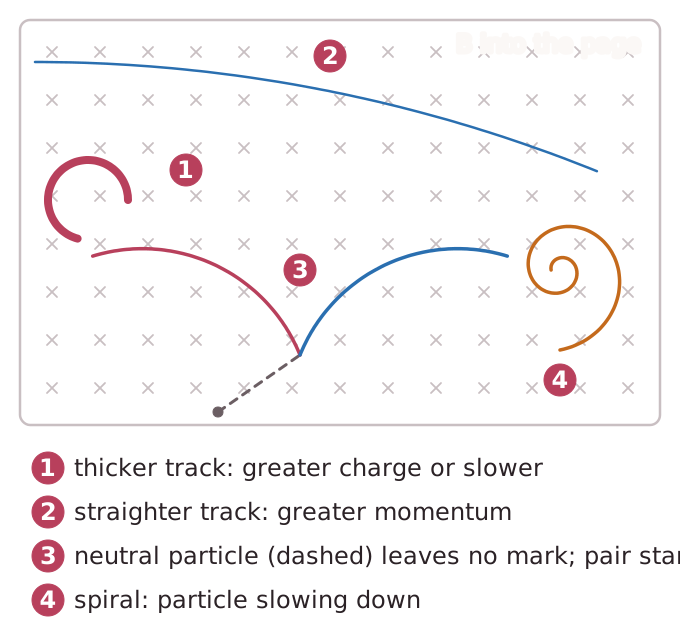
• in a cloud chamber, vapour condenses on the ions, leaving a trail of droplets
• in a bubble chamber, the liquid boils along the trail, leaving a line of bubbles
• in modern electronic detectors, the freed charges are collected and produce electrical signals, which a computer uses to reconstruct the tracksNeutral particles (such as neutrons, neutrinos and photons) do not ionise directly, so they leave no track. They are detected from the charged particles they produce. For example, a neutral particle that decays into two oppositely charged particles shows up as a V-shaped pair of tracks starting from nowhere.Deflection: a magnetic field is applied across the detector. Charged particles follow curved tracks, and:
• the direction of curvature shows the sign of the charge
• the radius of the track shows the momentum of the particle (a straighter track means greater momentum)Other clues: a thicker, denser track means strong ionisation (larger charge or slower particle); the length of a track shows how far the particle travelled before stopping or decaying; a track that spirals inwards shows a particle losing energy as it ionises, so its momentum and radius decrease.