Skip to content

Nucleophiles

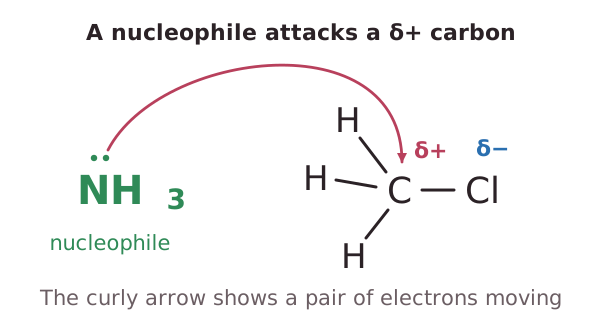
A nucleophile is an electron pair donor. It has a lone pair of electrons that it can donate to form a new dative covalent bond.Nucleophiles are electron-rich. They are either negatively charged ions, such as OH- and CN-, or neutral molecules with a lone pair, such as NH3 and H2O.Nucleophiles attack atoms that are electron deficient, such as positive ions or the δ+ carbon in a polar bond.For example, the δ+ carbon in the C-X bond of a halogenoalkane is attacked in nucleophilic substitution, and the δ+ carbon in the C=O group of a carbonyl compound is attacked in nucleophilic addition.
Read the text

Read the text and highlight anything you think is important. When you go on, the text is hidden and you answer from memory.

Specification: OCR Chemistry A (H432), A-level, 4.2.2 Haloalkanes. Topic: Reactions and Reactive Species.

Key terms in this lesson

nucleophilic substitution
A reaction mechanism in which a nucleophile donates a lone pair of electrons to an electron-deficient carbon atom, displacing a leaving group.
nucleophilic addition
A reaction mechanism in which a nucleophile donates a lone pair of electrons to the electron-deficient carbon atom of a pi bond, without any group being displaced.

More in Reactions and Reactive Species

All 20 lessons in Reactions and Reactive Species · All OCR A-level Organic Chemistry topics