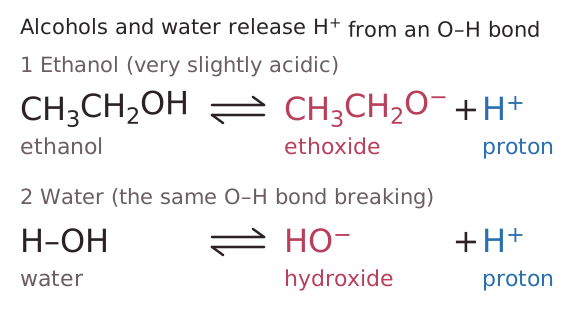
An acid is a proton (H+) donor. Carboxylic acids, phenols and alcohols all contain an O-H bond that can release a proton.Organic acids are weak acids. They only partially dissociate in water, for example CH3COOH ⇌ CH3COO- + H+.Carboxylic acids are the strongest of the three. They react with metals, bases and carbonates. The reaction with carbonates gives carbon dioxide gas, which is used to identify a carboxylic acid.Phenol is weakly acidic and reacts with sodium hydroxide but not with carbonates. Alcohols are only very slightly acidic and react with sodium metal to form an alkoxide and hydrogen.Strong acids such as concentrated sulfuric acid act as catalysts in organic reactions, for example in esterification and in the dehydration of alcohols.