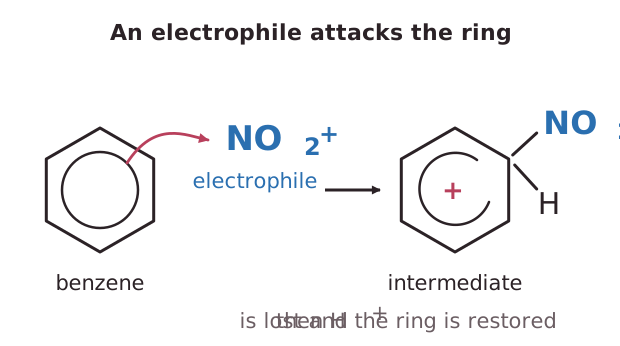
An electrophile is an electron pair acceptor. It is electron deficient and can accept a pair of electrons to form a new dative covalent bond.Electrophiles are positive ions, such as H+ and NO2+, or molecules with a δ+ atom, such as the hydrogen in H-Br.Electrophiles attack regions of high electron density. The π bond in an alkene and the delocalised ring of benzene are both attacked by electrophiles.A non-polar molecule such as Br2 can act as an electrophile when the electron-rich C=C bond polarises it, making one bromine atom δ+. This happens in electrophilic addition.
Electrophiles
Read the text
Read the text and highlight anything you think is important. When you go on, the text is hidden and you answer from memory.
Specification: OCR Chemistry A (H432), A-level, 4.1.1 Basic concepts of organic chemistry and 4.1.2 Alkanes. Topic: Reactions and Reactive Species.
Key terms in this lesson
- electrophilic addition
- A reaction mechanism in which an electrophile is attracted to and attacks an electron-rich double bond, and a nucleophile then bonds to the resulting carbocation.
More in Reactions and Reactive Species
All 20 lessons in Reactions and Reactive Species · All OCR A-level Organic Chemistry topics