Skip to content

Bases

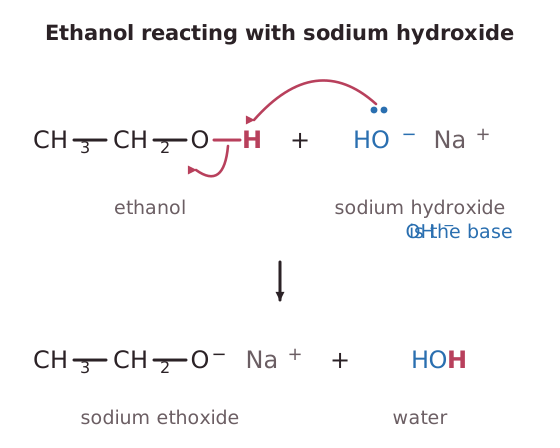
A base is a proton (H+) acceptor. In organic chemistry the hydroxide ion and amines are the most common bases.The hydroxide ion accepts a proton to form water. Sodium hydroxide neutralises carboxylic acids to give a salt and water, and reacts with phenol to form sodium phenoxide.Amines act as bases because the nitrogen atom has a lone pair that can accept a proton. Methylamine reacts with acids to form a methylammonium salt.Hydroxide ions in ethanol can also act as a base towards halogenoalkanes, removing a proton and causing elimination to give an alkene.
Read the text

Read the text and highlight anything you think is important. When you go on, the text is hidden and you answer from memory.

Specification: OCR Chemistry A (H432), A-level, 4.2.1 Alcohols and 4.1.1 Basic concepts of organic chemistry. Topic: Reactions and Reactive Species.

Key terms in this lesson

elimination
A reaction in which atoms or a small molecule are removed from a molecule, often forming a double bond.

More in Reactions and Reactive Species

All 20 lessons in Reactions and Reactive Species · All OCR A-level Organic Chemistry topics