 BRAINCAKE
Thin-Layer Chromatography
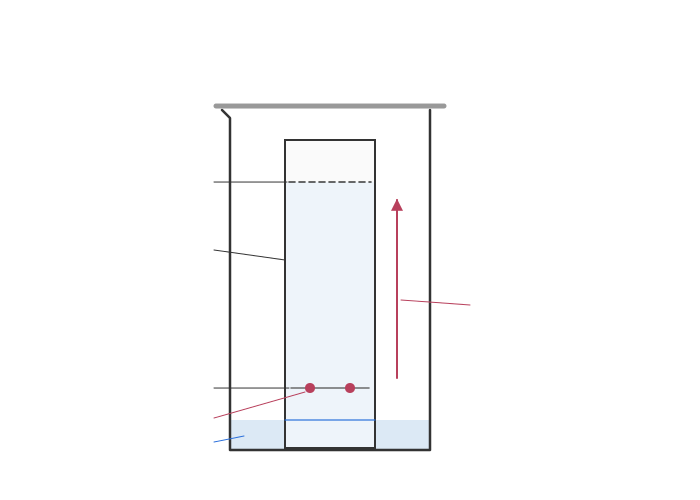
Thin-layer chromatography (TLC) is a quick way to find how many components a mixture contains, and to compare them with known substances.
The stationary phase is a thin layer of silica (SiO2) or alumina (Al2O3) on a glass, metal or plastic plate. The mobile phase is a solvent. Separation is by adsorption.
Sign in free to see the rest of this lesson, the R.E.C.I.P.E. recall steps and the quiz
BrainCake is free. Make an account in seconds and pick up where this page stops.
Key terms in this lesson
- stationary phase
- The phase in chromatography that does not move, and interacts with the components of a mixture to different extents.
- mobile phase
- The phase in chromatography, a liquid solvent or gas, that moves through or over the stationary phase carrying the mixture's components.
More in Chromatography and Qualitative Analysis
- Chromatography
- Rf Values
- Gas Chromatography
- Retention Times and Peak Areas
- Qualitative Tests for Alkenes
- Qualitative Tests for Haloalkanes
- Qualitative Tests for Phenols
- Qualitative Tests for Carbonyls
All 10 lessons in Chromatography and Qualitative Analysis · All OCR A-level Organic Chemistry topics