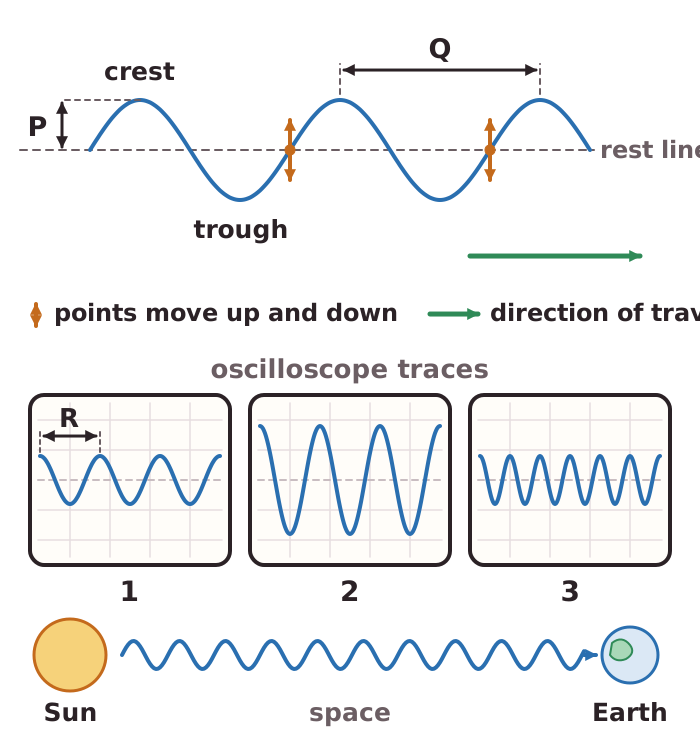
A wave transfers energy from one place to another without transferring matter. To describe a wave we use four quantities. The amplitude is the maximum displacement of a point on the wave from its rest position. The wavelength is the distance from a point on one wave to the same point on the next wave, for example from crest to crest.
The frequency is the number of complete waves passing a point each second, measured in hertz (Hz). The period is the time taken for one complete wave to pass a point, measured in seconds. The two are linked by period = 1 ÷ frequency, so a wave of frequency 4 Hz has a period of 0.25 s.
Sound waves can be displayed on an oscilloscope by connecting a microphone to it. A louder sound gives a taller trace, because its amplitude is bigger. A higher pitched sound gives a trace with more waves on the screen, because its frequency is higher.