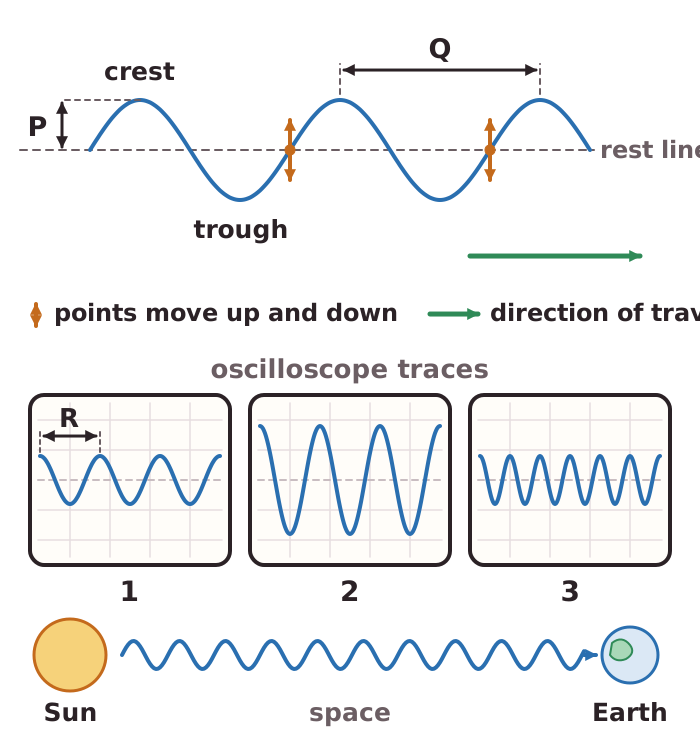
The wavelength of a wave is the distance from a point on one wave to the identical point on the next wave. You can measure it from one crest to the next crest, or from one trough to the next trough. Wavelength is a distance, so it is measured in metres (m).
The frequency of a wave is the number of complete waves that pass a point each second, or the number a source produces each second. It is measured in hertz (Hz). A frequency of 1 Hz means one wave per second, so 10 Hz means 10 waves pass every second. Larger units are used for fast vibrations: 1 kHz is 1000 Hz and 1 MHz is 1 000 000 Hz.
To find a frequency, divide the number of waves by the time taken in seconds. For example, a source making 60 waves in 5 seconds has a frequency of 12 Hz. Do not confuse wavelength with amplitude. Wavelength is measured along the direction the wave travels, while amplitude is measured at right angles to it.