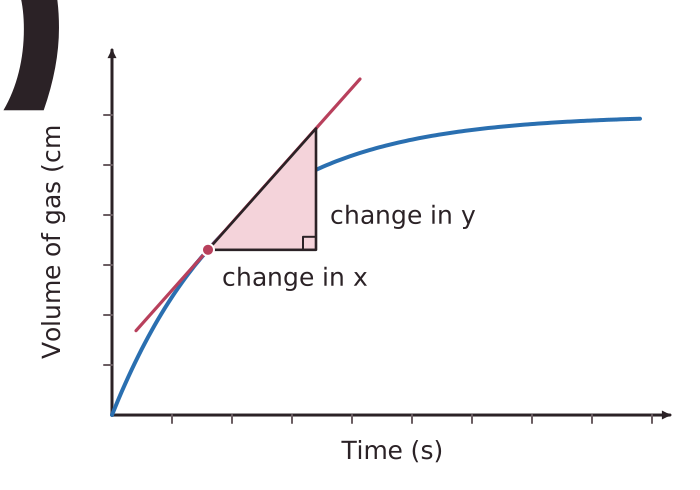
A common graph plots the volume of gas made (or the mass of product) against time. The line is steepest at the start, when the reaction is fastest. It then becomes less steep as the reactants get used up, and it goes flat when one reactant has been used up and the reaction has finished.
The gradient of the line is the rate of reaction. Gradient = change in y divided by change in x. For example, if the line rises from 0 to 30 cm3 in the first 10 s, the rate is 30 ÷ 10 = 3 cm3/s. A steeper line means a faster reaction.
If the line is a curve, the rate keeps changing. To find the rate at one moment, draw a tangent to the curve at that point and work out the gradient of the tangent.
Sometimes you measure the time taken, t, for a fixed change, such as a cross disappearing. The value 1/t is proportional to the rate of reaction. A reaction with t = 20 s has 1/t = 1 ÷ 20 = 0.05 per second. If the time taken halves, 1/t doubles and so the rate doubles.