For particles to react they must collide, and the collision must have enough energy. The minimum energy needed is the activation energy. Many collisions do not have this energy, so the particles just bounce apart without reacting.
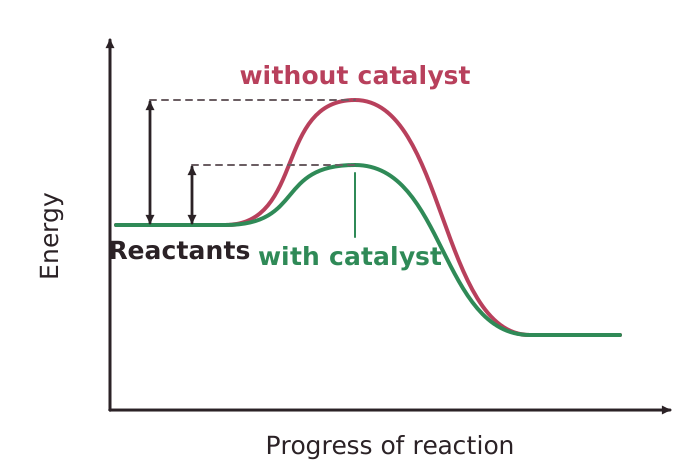
A reaction profile plots the energy of the chemicals as a reaction goes from reactants to products. The height of the peak above the reactants is the activation energy, often measured in kJ/mol. A catalyst provides an alternative pathway for the reaction. This pathway has a lower activation energy, so a catalyst lowers the peak. If a catalyst lowers the activation energy from 80 kJ/mol to 50 kJ/mol, it has cut it by 30 kJ/mol.
With a lower activation energy, more collisions are successful in each second, so the rate of reaction increases. The catalyst does not change the energy of the reactants or the products, so the overall energy change of the reaction stays the same. The catalyst is not used up, so it can keep working.