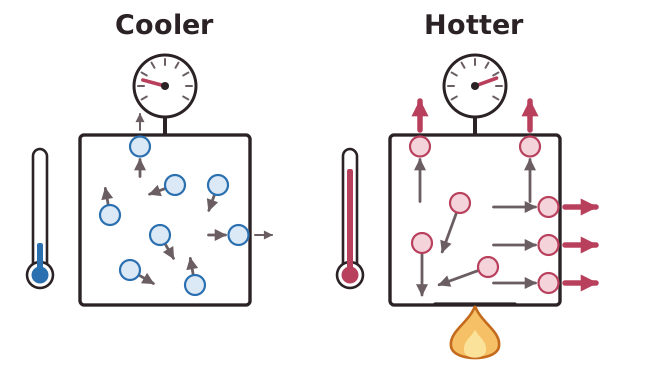
The particles in a gas move randomly at high speed. The pressure of the gas comes from these particles colliding with the walls of the container. Each collision gives the wall a tiny push, and the pressure is the combined effect of billions of these pushes every second.
The temperature of a gas is linked to the average kinetic energy of its particles. When a gas is heated, its particles gain kinetic energy and move faster, so their velocity increases. When a gas is cooled, the particles slow down.
Now take a fixed mass of gas in a sealed container of constant volume. Heating it makes the particles faster. They make more collisions with the walls, and each collision is harder because the particles are moving faster. The force on the walls goes up, so the pressure increases. Cooling the gas does the opposite and the pressure falls. Because the mass and the volume stay the same, the only thing that has changed is the speed of the particles.