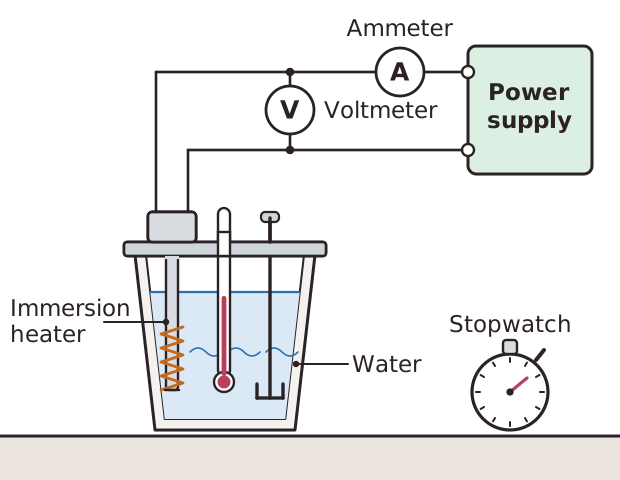
This core practical has two parts. In the first, you find the specific heat capacity of water. Pour a known mass of water into an insulated container, such as a polystyrene cup with a lid. Place a thermometer and an electric immersion heater in the water. Measure the energy supplied with a joulemeter, or use E = V × I × t with a voltmeter, an ammeter and a stopwatch.
Record the starting temperature, heat the water for several minutes while stirring so the temperature is the same throughout, then record the final temperature. The specific heat capacity is c = Q ÷ (m × temperature change). The accepted value is 4200 J/kg °C.
Some energy is always lost to the surroundings, so the energy supplied is more than the energy the water gains. This makes the calculated value of c too high. Insulation and a lid reduce this error.
In the second part, heat crushed ice in a beaker with a thermometer and record the temperature at regular times. Plot temperature against time. The temperature rises to 0 °C, then stays at 0 °C while the ice is melting because the energy is changing the state. Only when all the ice has melted does the temperature rise again.