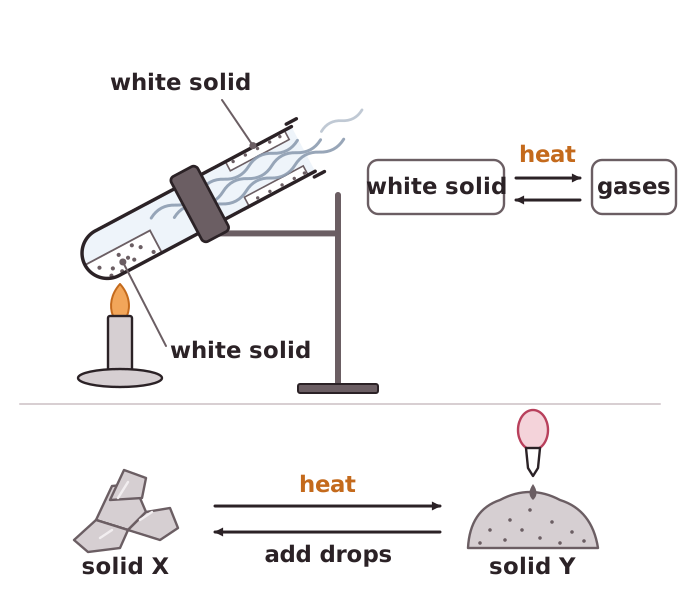
Many reactions go one way only, but some are reversible. In a reversible reaction the products can react to reform the reactants. We show this in an equation with the symbol ⇌ instead of an arrow, for example NH4Cl(s) ⇌ NH3(g) + HCl(g).
When ammonium chloride is heated in a test tube it breaks down into ammonia and hydrogen chloride gases. This is the forward reaction. The gases rise and cool near the top of the tube, where they react together again to form white solid ammonium chloride. This is the reverse reaction.
Another example is hydrated copper(II) sulfate. Heating the blue crystals drives off water and leaves white anhydrous copper(II) sulfate. Adding water to the white solid turns it blue again.
In both examples the direction of the reaction is changed by changing the conditions. Heating favoured the forward reaction and cooling or adding water favoured the reverse reaction. Changing the temperature is the most common way to alter the direction of a reversible reaction.